
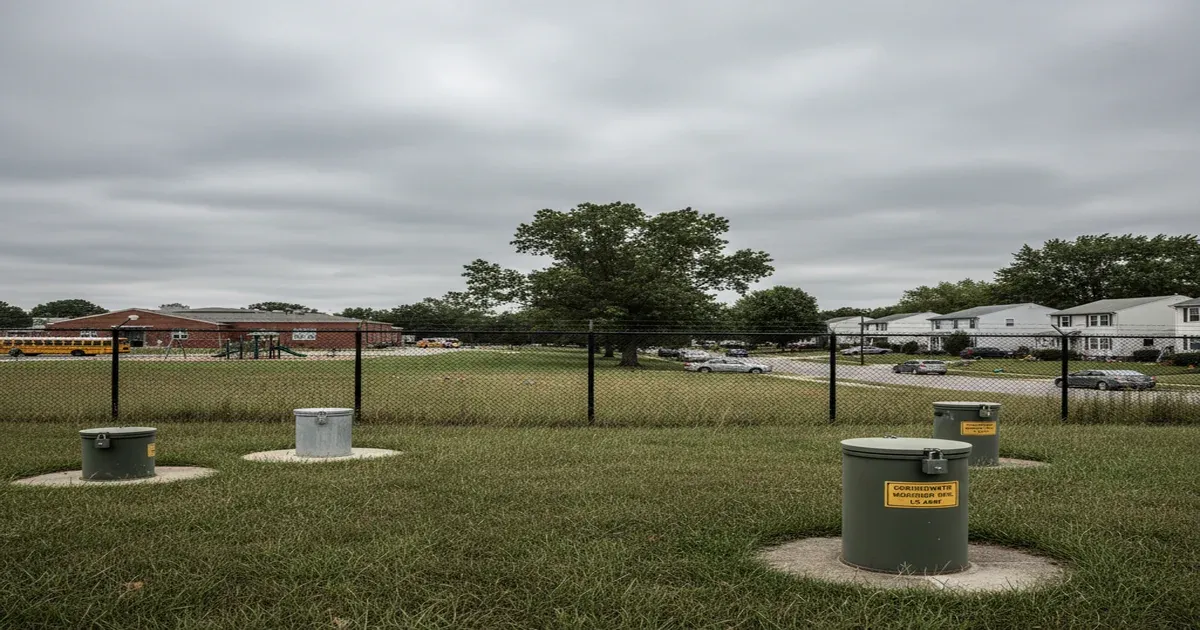
Frederick, Maryland — a city of about 78,000 people just 50 miles northwest of Washington, D.C. — has one of the most unusual water contamination stories in the country. Fort Detrick, the U.S. Army’s primary biodefense and medical research installation, sits in the middle of the city. And it brought decades of chemical contamination with it.
Fort Detrick: Area B Superfund Site
Fort Detrick has operated since 1943, originally as the center of the U.S. biological weapons program (discontinued in 1969) and later as the Army’s premier biodefense research facility. The installation’s “Area B” — a 400-acre section on the base’s western side — was listed on the EPA’s National Priorities List (Superfund) in 2009.
The contamination at Area B includes:
- Trichloroethylene (TCE) — A degreasing solvent used extensively on the base. TCE plumes have migrated off-base into Frederick’s groundwater, contaminating private and municipal wells.
- Tetrachloroethylene (PCE) — Another chlorinated solvent found in the groundwater beneath and around the base.
- Volatile organic compounds (VOCs) — Multiple other industrial solvents detected in monitoring wells.
- PFAS — Fort Detrick used AFFF (aqueous film-forming foam) for fire training, and PFAS compounds have been detected in groundwater on and near the base.
The Army has installed groundwater extraction and treatment systems to contain the TCE plume, but contamination has already spread well beyond the base boundary. Monitoring wells in residential neighborhoods east and south of Fort Detrick have shown elevated TCE levels.
The Cancer Cluster Controversy
Frederick residents have raised concerns about cancer rates in neighborhoods near Fort Detrick for years. While the Maryland Department of Health has conducted cancer incidence reviews, establishing a definitive causal link between specific contaminants and cancer rates is notoriously difficult.
What is documented:
- The Agency for Toxic Substances and Disease Registry (ATSDR) has been involved in health assessments related to Fort Detrick contamination
- Several community advocacy groups have pushed for more comprehensive health studies
- The Army has acknowledged the contamination but disputes the scope of off-base impact
The tension between military operations and community health is a recurring theme at Fort Detrick — and at military installations across the country.
Frederick’s Municipal Water Supply
The City of Frederick’s water system draws from:
- Fishing Creek Reservoir and Lake Linganore (surface water)
- Monocacy River (surface water)
- Several groundwater wells
The city’s water treatment plant provides conventional treatment including filtration, coagulation, and chlorine disinfection. According to recent Consumer Confidence Reports, the treated water meets all EPA standards.
However, the situation is more complicated than the CCR suggests:
- Some groundwater sources have been taken offline or treated specifically because of contamination from Fort Detrick
- The city has invested in blending strategies to dilute contaminants from affected sources
- PFAS testing has detected compounds in finished water, though at levels currently below EPA limits
What the Data Shows
Key findings from Frederick’s water quality monitoring:
- TCE — Below EPA MCL of 5 µg/L in finished water, but detected in source water from affected wells
- PFAS — Detected at low levels in finished water; Maryland has adopted a 10 ppt advisory level for PFOS and PFOA
- Disinfection byproducts — Trihalomethanes and haloacetic acids present within EPA limits
- Nitrate — Detectable from agricultural runoff in the Monocacy watershed but well below the MCL
- Lead — 90th percentile levels below the EPA action level, though older homes in Frederick’s historic district may have lead service lines
The EPA’s ongoing Superfund cleanup at Fort Detrick includes regular five-year reviews, and the most recent review identified areas where cleanup goals have not yet been met.
Private Well Owners at Highest Risk
Homeowners south and east of Fort Detrick who rely on private wells face the greatest exposure risk. The TCE plume has migrated in these directions, and private wells are not monitored by the city’s water system.
The Army has provided bottled water and whole-house treatment systems to some affected private well owners, but eligibility determinations have been contentious, and some residents feel the response has been inadequate.
Frederick County Health Department recommends annual testing for private wells, but compliance is voluntary and many wells go untested.
What Frederick Residents Should Know
- Know your water source — Are you on city water or a private well? The risks differ significantly.
- If you’re on a private well near Fort Detrick — Test for TCE, PCE, other VOCs, and PFAS. Contact the Army’s Restoration Advisory Board for information about contamination in your area.
- Review the CCR — Frederick’s annual water quality report is available from the city’s water department. Look specifically at source water detections, not just finished water.
- Consider additional treatment — Activated carbon filtration removes TCE and many VOCs effectively. Reverse osmosis handles PFAS. For well water near the base, both may be appropriate.
- Stay engaged — Fort Detrick’s Restoration Advisory Board holds public meetings. Community input has been critical in pushing for more comprehensive cleanup.
Frederick is a charming, growing city with excellent quality of life. But the presence of a major military installation with decades of chemical contamination creates water quality challenges that residents — especially private well owners — need to take seriously.
Water quality challenges like these aren’t unique to this area. Residents in Annapolis, Maryland Water Quality and Baltimore’s Aging Water Infrastructure face similar contamination concerns, while Washington DC Water Quality deals with its own set of water infrastructure and quality issues.
If you’re concerned about your water quality, a certified water treatment professional can test your water and advise on solutions tailored to your specific situation.