
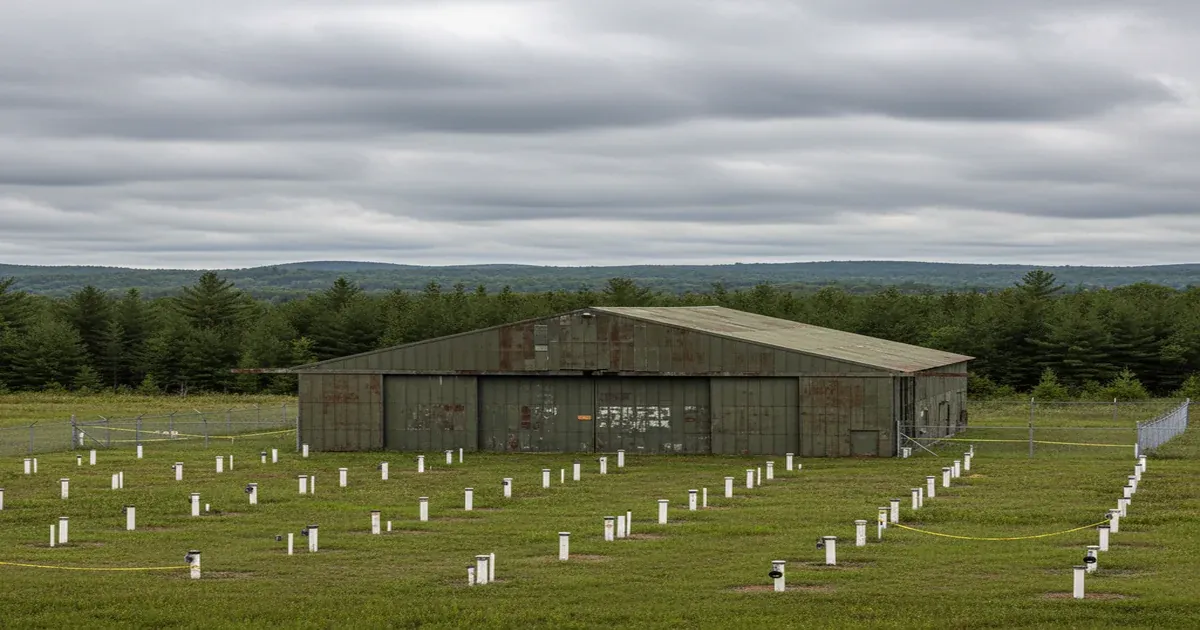
Bangor, Maine — home to about 32,000 people in the heart of central Maine — has become one of the most significant PFAS contamination stories in New England, and not for reasons the city would have chosen.
The former Dow Air Force Base — now Bangor International Airport — is the source of a PFAS plume affecting hundreds of private wells across a wide swath of Bangor and neighboring Orono, Hampden, and Newburgh.
Dow AFB: A PFAS Ground Zero
Dow Air Force Base operated from 1942 until 1968, when it was converted to civilian use as Bangor International Airport. During its military years — and during subsequent years as an operational airport — the installation used AFFF (aqueous film-forming foam) in firefighting training and emergencies.
AFFF contains PFOS and PFOA, the most well-studied and dangerous PFAS compounds. Decades of AFFF use soaked into the ground around the airport’s fire training areas, and the contamination has spread in groundwater far beyond the airport property.
The scope of the problem:
- Hundreds of private wells in Bangor, Orono, Hampden, Newburgh, and surrounding communities have tested positive for PFAS
- Some wells showed PFOS/PFOA levels exceeding 1,000 parts per trillion — far above the EPA’s health advisory of 70 ppt and astronomically above the new proposed MCL of 4 ppt
- The plume is still migrating — Groundwater flow continues to carry contamination to previously unaffected areas
- Maine adopted an MCL of 20 ppt for the sum of six PFAS compounds in 2022 — among the nation’s strictest — making more wells technically non-compliant
The State of Maine and the federal government have provided bottled water and whole-house filtration systems to some affected well owners, but coverage has been incomplete and the politics of responsibility (airport authority vs. Air Force vs. state vs. private property owners) have been contentious.
Bangor Water District: Protected But Not Immune
The Bangor Water District serves the city and several surrounding communities with treated surface water and groundwater. The district’s primary sources include:
- Floods Pond in Otis (a pristine, protected lake)
- Orono Bog Watershed and other surface water sources
- Groundwater wells in various locations
The good news: Bangor Water District sources are geographically separated from the primary PFAS plume and have tested below Maine’s strict MCLs. The city’s treatment system includes granular activated carbon (GAC) that provides some PFAS removal.
However:
- Some district groundwater wells are in areas where long-term monitoring is warranted
- Atmospheric deposition of PFAS affects all open water sources statewide
- As the PFAS plume continues to migrate, future well impacts cannot be ruled out
Penobscot River: Context and Concerns
The Penobscot River runs through the heart of Bangor. The river has improved dramatically from its industrial nadir of the mid-20th century, when paper mill discharges made it one of the most polluted rivers in the Northeast. But challenges remain:
- Legacy contamination — Paper mills used a variety of chemicals over their operating lives, some of which persist in river sediments
- Mercury — Historical industrial sources have deposited mercury in Penobscot watershed sediments
- Dioxin — Some paper mill processes produced dioxin as a byproduct; legacy contamination in river sediments is a concern
- Stormwater — Urban runoff from Bangor adds petroleum products, heavy metals, and bacteria to the river
The river is not Bangor Water District’s primary source, but it reflects the broader environmental health of the region.
What the Data Shows
For private well owners (the critical population):
- Hundreds of wells in the plume area have tested above Maine’s 20 ppt PFAS MCL
- Some wells have tested above 1,000 ppt for individual PFAS compounds
- Maine’s PFAS monitoring program continues to find newly affected wells as testing expands
For Bangor Water District customers:
- Most recent CCR shows all regulated contaminants within EPA and Maine state limits
- PFAS below Maine’s 20 ppt standard
- Lead at 90th percentile below action level
- Disinfection byproducts within limits
What Bangor Residents Should Do
- If you’re on a private well in the Bangor/Orono/Hampden/Newburgh area — Test for PFAS immediately if you haven’t already. Maine CDC has coordinated free PFAS testing for affected areas; check current program availability.
- Know the plume map — Maine DEP and the Bangor Water District have published maps showing known PFAS contamination areas. Locate your well relative to the plume.
- Don’t wait for symptoms — PFAS contamination has no taste or odor. You won’t know your water is contaminated without testing.
- Demand a treatment system — If your well tests positive above Maine’s MCL, you may be eligible for a whole-house PFAS treatment system (reverse osmosis or activated carbon) provided through state or federal programs. Contact Maine DEP.
- Bangor Water District customers — Your treated water meets Maine standards, but request the most current PFAS data and monitor updates as federal regulations tighten.
Bangor’s PFAS crisis is a story still unfolding. The contamination was created decades ago, and the full extent of its reach is still being discovered. Staying informed — and tested — is essential.
Water quality challenges like these aren’t unique to this area. Residents in Augusta, Maine Water Quality and Portland, Maine Water Quality face similar contamination concerns, while Lewiston-Auburn, Maine Water Quality deals with its own set of water infrastructure and quality issues.
If you’re concerned about your water quality, a certified water treatment professional can test your water and advise on PFAS removal systems appropriate for your situation.