
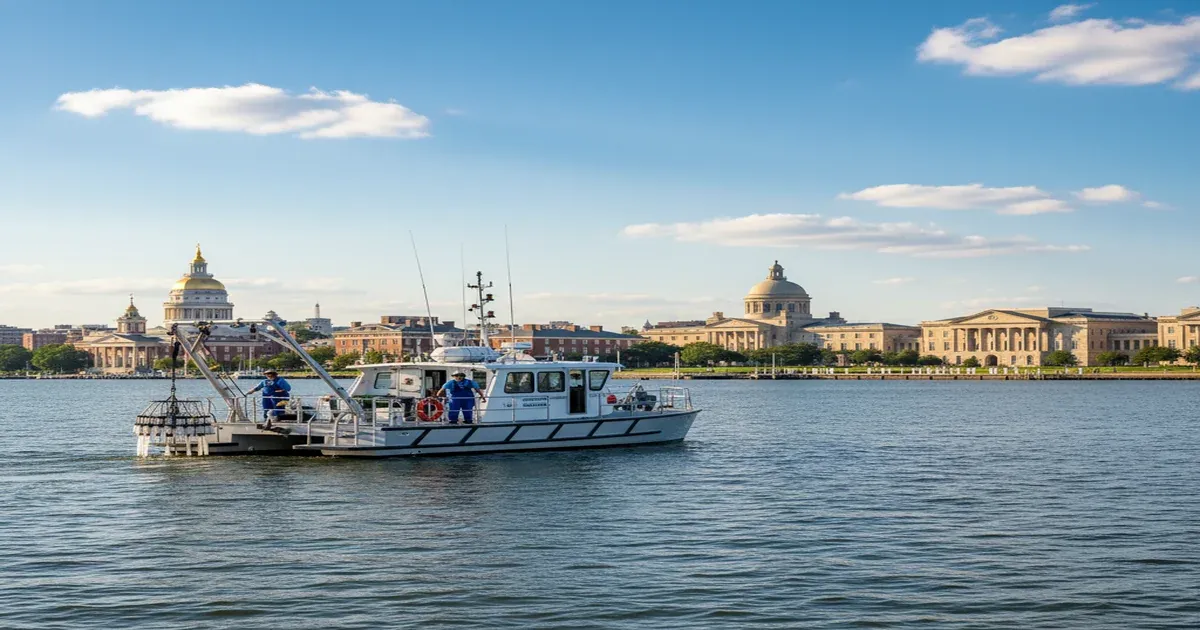
Annapolis, Maryland — the state capital and home of the U.S. Naval Academy — occupies a scenic peninsula where the Severn River meets the Chesapeake Bay. That geography is both the city’s greatest asset and its most significant water quality challenge.
The Chesapeake Bay: An Impaired Watershed
The Chesapeake Bay is the largest estuary in the United States, draining a watershed covering 64,000 square miles across six states and Washington, D.C. It’s also on the EPA’s list of impaired water bodies, with decades of effort and billions of dollars invested in restoration.
The primary water quality problems in the Bay watershed directly affect Annapolis:
- Nutrient pollution — Nitrogen and phosphorus from agricultural runoff, wastewater treatment plants, and urban stormwater feed algal blooms that deplete oxygen and create “dead zones” in the Bay’s bottom waters
- Sediment — Runoff from construction sites, farms, and developed land smothers underwater grass beds and fish habitat
- Bacteria — Combined sewer overflows from Annapolis and other Bay cities discharge untreated sewage into the estuary during heavy rains
- Chemical contamination — Decades of industrial activity around Baltimore and across the watershed have left heavy metal and organic chemical contamination
Annapolis draws its municipal drinking water from the Severn River and Patuxent River watershed — both Chesapeake Bay tributaries. The quality of these source waters directly reflects the health of the broader watershed.
PFAS: The Naval Academy Connection
The U.S. Naval Academy has been a fixture in Annapolis since 1845. Like other military installations, the Academy used AFFF (aqueous film-forming foam) containing PFOS and PFOA for decades in firefighting training.
PFAS contamination associated with Naval Academy operations has been documented:
- The Department of Defense has conducted PFAS investigations at the Academy grounds
- Monitoring wells on and near the Academy property have detected PFAS compounds
- The proximity to the Severn River and Chesapeake Bay raises concerns about PFAS migration into surface water and the broader estuary
Maryland has adopted some of the stronger PFAS standards in the Mid-Atlantic region, and the state Department of the Environment has been actively monitoring public water supplies. Anne Arundel County’s water utility tests for PFAS and has reported results below state action levels.
Saltwater Intrusion: A Growing Threat
As sea levels rise in the Chesapeake Bay region (one of the fastest rates of relative sea level rise on the East Coast due to a combination of actual sea level rise and land subsidence), saltwater intrusion is threatening coastal aquifers.
For Annapolis and surrounding Anne Arundel County:
- Private wells near the shoreline are increasingly showing elevated chloride and sodium as saltwater pushes inland through permeable aquifer materials
- The Magothy aquifer, a primary groundwater source for many Anne Arundel County residents, faces long-term salinization pressure
- Storm surge events — extreme tidal flooding, which has become more frequent in Annapolis, can temporarily overwhelm coastal groundwater with saltwater
Property owners on the Chesapeake Bay shoreline and on low-lying peninsulas are at greatest risk.
Annapolis Municipal Water System
Anne Arundel County’s water system (which serves Annapolis and surrounding communities) draws from:
- Patuxent River at the Patuxent Water Reclamation Facility
- Severn River as a supplemental source
- Groundwater wells from the Magothy and other aquifers
The system uses conventional treatment plus additional processes to address the specific challenges of Chesapeake Bay tributary water. According to the county’s most recent Consumer Confidence Report, all regulated contaminants are within EPA limits.
Key data points:
- Trihalomethanes and haloacetic acids from chlorination — within EPA limits but present
- Low-level detections of several pharmaceuticals and personal care products (not currently regulated under federal rules)
- Nitrate within limits but measurable from watershed agricultural runoff
- Lead at the 90th percentile below the action level
Combined Sewer Overflows: The Sewage Problem
Annapolis has a combined sewer system in its older districts, meaning stormwater and sewage share the same pipes. During heavy rain:
- The system becomes overwhelmed
- Untreated sewage and stormwater overflow into local waterways
- The Severn River and Chesapeake Bay receive these overflows
The city has invested in sewer separation projects, but the work is expensive and incomplete. Combined sewer overflows are less a drinking water problem than a recreational and ecological one — but they signal the broader infrastructure challenge Annapolis faces.
What Annapolis Residents Should Do
- Ask about PFAS — Contact Anne Arundel County Bureau of Utilities for their latest PFAS test results and compliance status under new EPA rules
- Know your water source — Are you on county water or a private well? Coastal private well owners should test for chloride, sodium, and hardness to detect saltwater intrusion
- Lead awareness — Older homes in Annapolis’s Historic District may have lead service lines or indoor plumbing with lead solder. Test and filter accordingly.
- Don’t swim after rain — Combined sewer overflows make the Severn River and local Bay waters potentially unsafe for several days after significant rainfall
- Support Bay restoration — The health of your drinking water source is directly tied to the health of the Bay watershed. Reducing nutrient runoff from your own property (fertilizer management, impervious surface reduction) contributes to the solution.
Annapolis’s water quality story is inseparable from the Chesapeake Bay’s story. A cleaner Bay means cleaner source water. The investment in Bay restoration is, in part, an investment in Annapolis’s water supply.
Water quality challenges like these aren’t unique to this area. Residents in Frederick, Maryland Water Quality and Baltimore’s Aging Water Infrastructure face similar contamination concerns, while Washington DC Water Quality deals with its own set of water infrastructure and quality issues.
If you’re concerned about your water quality, a certified water treatment professional can test your water and advise on appropriate treatment solutions.